
Hash Bash Protest 2026: The Pilgrimage of Freedom


The Hash Bash Protest 2026 is not simply an event you attend. Standing in the crowd at the Hash Bash Protest 2026 means stepping into a living timeline shaped by decades of activism, expression, and community. Every generation inherits a world shaped by the one before it, and for more than half a century, those questions and that resistance have gathered in Ann Arbor.
The Hash Bash Protest 2026 represents more than a protest. What began as a demonstration has evolved into a political movement, a countercultural ritual, and a grassroots pilgrimage. The Hash Bash Protest 2026 continues to draw people from across the country because it speaks to something deeper than policy—it speaks to the human need for unity when systems fail to reflect the will of the people.
To understand the Hash Bash Protest 2026, you must understand the world that created it. The generations before it prioritized stability after surviving the Great Depression and World War II. But those same systems created a new generation that began questioning authority, conformity, and control—laying the foundation for what would become the Hash Bash Protest 2026.
The cultural shift that led to the Hash Bash Protest 2026 took shape in the 1950s and 1960s. Movements like the Beat Generation and student activism on college campuses challenged societal norms. At the University of Michigan, students helped author the Port Huron Statement, pushing for participatory democracy and laying intellectual groundwork that would later fuel gatherings like the Hash Bash Protest 2026.
The era surrounding the Hash Bash Protest 2026 origins was marked by massive change. The Civil Rights Movement, protests against the Vietnam War, and growing distrust in government institutions all converged. Ann Arbor became a central hub for these conversations, setting the stage for what would evolve into the Hash Bash Protest 2026.
In 1968, the White Panther Party formed in Ann Arbor, advocating for cannabis legalization and social reform—ideas that directly connect to the spirit of the Hash Bash Protest 2026. Shortly after, the Human Rights Party pushed progressive policies, including reduced cannabis penalties. Meanwhile, federal laws like the Marihuana Tax Act of 1937 and the Controlled Substances Act of 1970 intensified prohibition, creating the very tension that the Hash Bash Protest 2026 still challenges today.
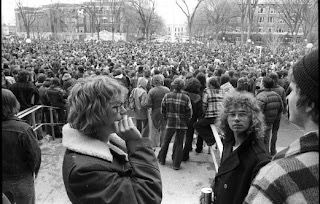
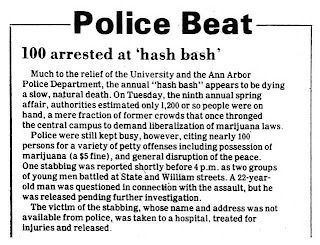
The roots of the Hash Bash Protest 2026 trace back to April 1, 1972, following the People v. Sinclair decision. When the Michigan Supreme Court invalidated certain cannabis laws, people gathered in Ann Arbor to celebrate and protest ongoing prohibition. There was no organization—just people showing up. That spontaneous act became the foundation of what is now the Hash Bash Protest 2026.
The Hash Bash Protest 2026 cannot be separated from the impact of the War on Drugs, declared by Richard Nixon in 1971. This policy led to decades of aggressive enforcement, disproportionately affecting marginalized communities. Even today, despite legalization in many areas, thousands remain incarcerated for cannabis-related offenses—one of the driving reasons the Hash Bash Protest 2026 still matters.
Now in its modern era, the Hash Bash Protest 2026 exists in a space filled with contradiction. In 2026, cannabis is still prohibited on the campus of the University of Michigan due to federal law. Enforcement remains active, meaning the very act being protested at the Hash Bash Protest 2026 is still restricted in the space where it takes place.
The environment surrounding the Hash Bash Protest 2026 has also shifted. Elements that once gave it a festival-like atmosphere are fading, revealing its true identity. The Hash Bash Protest 2026 was never meant to be a party—it was always meant to be a demonstration, a refusal to accept injustice quietly.
In a world where authentic public gatherings are increasingly rare, the Hash Bash Protest 2026 stands out as one of the few truly organic annual events in the United States. Every year, thousands gather at the Diag in Ann Arbor, transforming the space into something that cannot be replicated online. The crowd itself becomes the meaning behind the Hash Bash Protest 2026.
Even as cannabis laws evolve, the core message of the Hash Bash Protest 2026 remains unchanged. It is about accountability, justice, and collective voice. For over fifty years, people have made the journey not because they have to—but because they understand the power of showing up. The Hash Bash Protest 2026 is a reminder that when people gather with purpose, they become part of something larger than themselves.
The Hash Bash Protest 2026 is not a festival. It is not a moment. It is a continuum. And when you step into it, you are stepping into history.


Comments